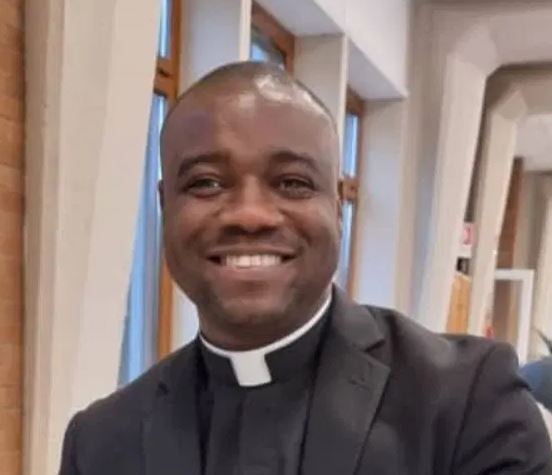
His abduction sent shock waves through the Catholic Diocese of Auchi, leaving the community in a state of anguish and despair.
On the evening of October 27, 2024, an unsettling sense of dread descended upon the usually tranquil Immaculate Conception Seminary in Agenebode, Etsako East Local Government Area of Edo State, leaving priests and seminarians on edge.
Gunmen stormed the seminary, shattering the peaceful atmosphere of evening prayers and benediction, and making off with the Rector, Reverend Father Thomas Oyode. His abduction sent shock waves through the Catholic Diocese of Auchi, leaving the community in a state of anguish and despair.
However, on Wednesday, November 6, 2024, a glimmer of hope emerged. Reverend Father Oyode was released and found at a village close to Ajaokuta, Kogi State, at 7 pm. The ordeal had taken a profound toll on Reverend Father Oyode.
The trauma and anguish etched on his face told the story of a man who had faced the depths of human cruelty. Efforts to speak with him since his release last November were met with reluctance as he appealed to be left alone to get medical treatment and recover from the psychological trauma. Finally, he obliged the Deputy Crime Editor, Evelyn Usman’s request, four months later, recalling how it all happened .
Excerpts:
Father, how were you abducted and did they announce their presence with gunshots ?
Yes. They announced their presence with gunshots, but I didn’t realise we were in danger at the time. It was around 7.00pm. We usually have the vigilante come to resume night duties at 8.00pm, and he would usually shoot a shot up, perhaps to announce his presence. When I heard the first gunshot where I was seated, I thought he was the one. Then there was a second one and I thought to myself, “why is he wasting the bullets?”.
It was at that very moment I heard feet stamping towards me. I raised my head and saw three young men looking like Fulani, brandishing a cutlass, a stick and a gun respectively. I was terrified and started screaming “Jesus! Jesus! Jesus! Mother Mary, Help Me! Ikenemoh, where are you?”. This made them hit me harder, as they would later tell me when they took me to the bush.
As they hit me with every instrument they held, I fell to the ground, and it appears I passed out because I later found myself almost lifeless on another spot far from where they began hitting me and I didn’t know how I got to that spot. I felt one of them trying to lift me up, saying “oya come make we dey go”. I tried to open my eyes then I discovered that my left eye was already covered, I couldn’t see with it. It was swollen. The right eye was covered with blood. I could barely see but I managed to see two of my Seminarians being held hostage; one looked like he was explaining something or pleading to be freed. He was gripped by the collar of his uniform.
It was then that I realised that we were not just being attacked by some angry herdsmen, we were going to be kidnapped. So I managed to stand on my knees, lifted my hands and pleaded with them, “Okay, make una leave these ones, I go follow una. I’m a priest, abeg I go follow una” and they said “Oya get up make we dey go.” They tied my hands and took me away.
At this point I noticed that the number of the attackers increased. There were now about ten of them. Later I discovered that they were actually nine in all. That was how they took me away.
How were you treated during your 10 days in captivity?
It was actually ten days, though I got home (my diocese) on the eleventh day, having passed the night in a village in Ajaokuta local government, Kogi State. I ate nothing that Sunday before the evening of the kidnap. I said three Masses in the morning at 5.30 am, 6.30am and 8.30am. From the Parish I proceeded to the seminary around 12.00 noon where I presided over a meeting between 1.00pm and 4.00pm when I went into my room for a nap.
I was hungry and thirsty when they came. So, when we walked a short distance, my throat became very parched. I asked for water but they told me that I couldn’t drink anything then “because of your condition”. I guess they were referring to the bleeding. Later in the night, they gave me water from a muddy river, but I rejected it. I thought they had potable water (pure water sachet) for me.
The next morning, they offered me cornflakes which they called garri but I couldn’t eat it. It was then I noticed that tears dropped from my eyes. They had broken my left jaw, and I could not open my mouth to chew even as my left eye had become swollen and closed up arising from the broken jaw. I realised that I was going to suffer a lot for as long as I was going to be alive in the forest. So I didn’t eat. I only drank water and sometimes, I asked them to add garri to the water for me to drink. That was what I fed on for ten days.
Were you able to maintain your faith and spiritual practices while in captivity?
My faith was the only thing I had left. Nothing else mattered to me anymore, not even my life because by Wednesday, I was already prepared for death. I only needed an opportunity to go for confessions. I gave up everything, I mean everything. Yet I realised that I could talk to God. I talked frequently with God. I asked him why I had to die by kidnapping when there were other ways to die. I said my rosary with my fingers. I had my chaplet on my neck but I refused to take it off and pray with it in case the kidnappers decided to seize it from me.
So I prayed with my fingers even the Divine Mercy prayer at 3.00pm every day. On one of the nights when they had my hands tied to the back and tortured me, the one they called Gambo kept shouting at me to keep quiet as I was crying and begging. He told me “keep quiet now or I’ll shoot you”.
As I pleaded the more with my hands already numb, he asked me, “If I release you now and tell you make you dey go, make you become Muslim, you go do?” For split seconds I considered the option and I immediately realised they would never release me after all. So, I asked, “me?”. He answered, “yes” and then I said “I be Reverend Father o”. He said “I know na” and then I said “no, I no go do”. He kept silent and never said anything again.
How did my belief sustain me? I have gone through much in my life as a human being and only my faith in God has kept me this far. Even if I didn’t become a priest I would still hold on to my Christian faith. On Wednesday about the 4th day, as I prayed the Divine Mercy that afternoon, I realised that I was giving up hope, I was not only in despair, it seemed like depression was creeping in. I laid my hands on my head declaring divine life upon myself counting on the promise of the Lord in John 10:10.
So I cast out every spirit of death, darkness, witchcraft, poison, any connection with marine powers, the forces of evil, whether it be by physical contact, through food, through water, through incantations or through resentment, envy and jealousy. I spoke into my spirit, into the depth of my stomach. I declared that I may vomit it or piss it out from my being. I cast and bound every negative thought. From that day I began to gain strength and light. I was still afraid of dying but I was no longer in despair, or in that state of meaninglessness in which I was before that moment. So my faith sustained me.
Did you have any interactions with your captors that stood out to you, either positively or negatively and what was their reaction like when they discovered you were a Rev. Father?
Between Sunday, 27th and Thursday 31st of October, there were two of the guys who could speak pidgin English very well. They were herdsmen but they could converse in pidgin like a normal Southerner or ‘Bendelite’. There were a lot of outstanding moments in such conversations that wouldn’t be immediately mentioned in this interview for want of space. When I am fully healed, I would put my experience together in a book. Some of them were hilarious.
Like when one told me, “no worry, your people go soon come carry you. You go go house tomorrow by the grace of God”. Or when another (he led the way through the bush and forests) said “oga you be better person o! you just beg make dem leave those two boys come carry you go” or when they kept telling my pregnant sister to go use her money to prepare for my funeral: “God punish you, go use the money do burial”.
They knew I was a Reverend Father but they never understood what it meant. Sometimes, they would call me “pastor”, other times they would call me “teacher” or “oga”. One night, one of the youngest among them who always enjoyed beating us, came to me and asked me if I had a daughter. I felt he was in his heat. I simply answered, “no” and I imagined that if there were a female in our midst, he would have thought of raping her.
How did you pass the time while in captivity and were you the only captive?
I passed the time sleeping, lying on the floor with my eyes to the skies, saying short, silent prayers or thinking about my life and how I found myself in such an excruciating and depressing ordeal. This usually takes place during the day. At night we would walk through farmlands, rivers, hills, mountains and stony lands and put up somewhere before dawn. I could not communicate with anyone outside my captives. They captured another young labourer from Okpella on Wednesday night.
I heard the gunshots and was terrified. He was with me until Sunday night (November 3rd). We did not speak to each other except when I would tell him “oga, doh”, that is, sorry for the pain he was going through or when they would bring food and he would ask me if I wasn’t eating and I would tell him to go on that I could not eat and he would say that the food was too much for him alone.
What was the most challenging part of your experience, and how did you cope with it?
The most challenging part of my experience was fear. Fear of being killed, fear of falling sick. I am asthmatic. I can’t stand dust, cold, smoke and bleached oil or excess oil in my meal. I can’t stand foul smells or stuffy environments. So I feared that if I didn’t fall sick today, it could happen the following day. How did I cope? I didn’t know what kept me through the ten days until I came out and at the meeting with my Bishop, he told me that the Nigerian CWO (Catholic Women) were offering regular night prayers.
Then I saw on social media that there were different networks and gatherings of prayer for me globally. So, you see how I coped? It was through the prayers of family members, friends and people of goodwill all over the world. It is a testimony of divine providence.
Did you have any idea why you were abducted, and did your captors make any demands?
I have no idea why I was kidnapped other than monetary gains. They kept calling and asking for money and food.
How did your release come about?
I kept hoping I would be released. I kept praying even when there were instances when I felt they were planning to kill me, I could only pray for mercy and beg God to grant me the grace to join the Blessed Virgin Mary and my favourite saints in heaven.
My release was a mix of surprise and hope because there were times when it felt like it was never going to happen, like no matter what, they would kill me and abandon me in the bush anyway. I walked with them barefooted to Kogi State, near Ajaokuta Local Government Area. That was where they released me, where my people came to pick me on a motorcycle.
How has your experience affected your perspective on life and your faith? Has it changed you in any way?
My experience has affected my perspective on life. Each time I think of this question of perspective, I remember how I felt when my father died. Everything became meaningless. I was taking my final exams in Rome then and it no longer mattered to me at that point whether I graduated with a first class or a pass. I saw death, I saw powerlessness, I saw meaninglessness.
It is the height of man’s struggles with helplessness. My experience has taught me that the worst can happen in life and there is no need to be afraid of anything or anyone. These days, I feel like a war veteran, you can’t threaten me.
What message would you like to share with others who may be going through similar experiences?
If there is anyone going through captivity or abduction at the moment, he should hold on strong. Your people love you; family, friends, colleagues, acquaintances, and even those you do not know care so much about you. They are praying and working for your safe release. But when you are released, prioritise your healing, seek help and go through therapy. Be grateful.
Were you kept in a house or in a forest and how have your community and the Church supported you since your release?
I wasn’t kept in a house or building. We were out in the forest, walking at night in the dark and resting during the day. I slept on grass and sometimes on dry cow dungs or rocks. My experience was peculiar, so I had even Muslims, African Traditional worshippers praying for me. The entire Christian community globally has rallied around me and the seminary.
Some individuals, groups, organisations and dioceses in Nigeria and abroad have offered to assist in my healing process, offering me invitations to Europe and America, and have also made contributions towards the improvement of the security conditions of the seminary. Let us say what began as evil for the seminary has ended for the good of the seminary.
What is your message to your captors, and do you forgive them for what they did to you?
If you ever see them and ask them, I’m sure that they will tell you that I never had any resentment towards them. Somehow, I felt that they didn’t know what they were doing. They looked very ignorant but they also appeared kind except that they were engaged in an evil act. Kidnapping is unjustifiable. I hold nothing against them. I don’t even think about them specifically. Only one of them never stopped shouting at me and insulting me in Hausa (he never spoke one word in English). He was the second of them who held the AK 47. I thought of him as a sniper ready to shoot if I made any move.
He walked immediately behind when we walked and would hurry me to walk fast as I was very tired. I said earlier that my left eye was swollen and closed; my head was bleeding from a cut and the blood covered my right eye. The rest looked at me with love and pity. They pitied me. However, these days wherever I see Hausa/Fulani gathered, I just remember my experience and say “see them, kidnappers”
Does it bother you that many Rev. Fathers have been victims of kidnap with some of them killed in the process? What do you think is the solution to this?
I am a full-blooded Nigerian. I love this country as any average Nigerian would. When I was returning from Rome, a priest asked whether I was going to be able to cope with the adverse conditions in Nigeria. I told him “why I no go cope? No be Nigeria dem born me? Only four years wey I comot naim I no go fit cope?”. I was ready to be home and to live my life as a priest and enjoy the social and community life that is Nigeria.
So it bothers me that Priests have become endangered species in Nigeria; they have become targets for kidnappers, bandits and terrorists. I want things to turn around for good for this extremely endowed country of ours. Precisely for this reason, I encourage our leaders everywhere (political or otherwise) to be more disciplined and cultivate the quality of good listening. The lack of discipline and gross impunity is the breeding ground for corruption that we see even among highly placed religious people (not to mention our politicians). Our leaders are too high handed with an air of “I know it all”.
What do I think is the solution? State Governments (not Federal) should recruit the vigilante. Let us forget about the clamour for state police; the police have said that they don’t go into the bush. Recruit the vigilante and post them in the forest like Forest Rangers. They should patrol the forests especially at night. Now, you must motivate them by equipping them well with solid boots, bullet proofs, high powered motorcycles, ammunition and an irresistible, handsome remuneration. They should patrol the forests and leave roadblocks for soldiers and police.
In the cases of kidnapping that have taken place in Weppa and Uwanno, Etsako East Local Government Area of Edo State in the last two months since my ordeal, the captives were taken through the forests on foot, not along the road and it is usually in the hours of 6.30pm and 9.00pm. Government also needs to challenge the military on intelligence gathering.
We all need to ask ourselves: “where do these Hausa/Fulani get AK 47s from? How do they move them around without being caught? Who is supplying them? What is the police doing to track the phones of kidnappers as they would call a number of times each day? Is it that we do not have the right equipment to track and triangulate these marauders? Who is sponsoring these young boys?” The questions can go on and on, but it is the responsibility of the government to answer them. That is why they came to us begging us to vote them into government.