
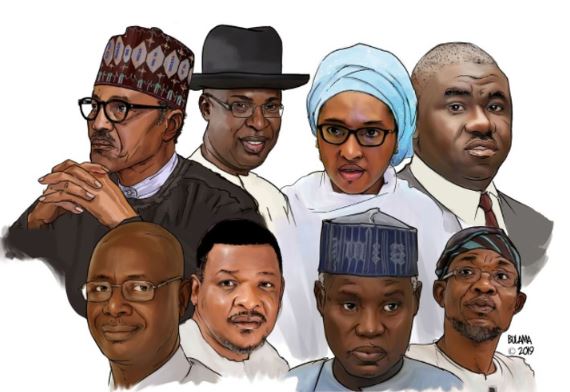
Bashir
Magashi (Defence) Terrorism, banditry, kidnapping and other forms of
insecurity have eroded the successes earlier recorded by the Buhari-led
administration.
Out of the 43 ministers recently inaugurated by President Muhammadu
Buhari, five of them will contend with serious headaches following the
myriad of challenges on ground at their respective ministries.
President Muhammadu Buhari had in the ministerial retreat before
the inauguration charged the ministers to be ready for “laborious days”.
As they settle down for their ministerial duties, so the challenges
cutting across national spheres will be coming up, like the morning dew.
Here are the ministers with biggest tasks ahead.
Bashir Magashi (Defence) Terrorism, banditry, kidnapping and other
forms of insecurity have eroded the successes earlier recorded by the
Buhari-led administration.
Under Mansur Dan-Ali, the predecessor of Magashi in the Ministry of
Defence, security challenges escalated across the country. Each of the
six geopolitical zones of the country battled with one form of
insecurity or the other. The performance of Dan-Ali was ballooned by the
nefarious activities of armed bandits in Zamfara, his home state. All
eyes are now on Magashi, a former military administrator of Sokoto
State, to turn the tide. Hours after he was sworn in, Boko Haram
insurgents took over control of Gubio town, headquarters of Gubio Local
Government Area of Borno State, though the situation was later brought
under control.
The Kano-born retired General is expected to address the presumed
rivalry among the security chiefs. When he appeared before the Senate
for screening, he said rivalry among the security chiefs contributes to
the escalation of insecurity. Another challenge the new defence minister
will face is the seeming prevailing bad blood between the army and the
police. The recent killing of police officers who were on a mission to
arrest a kidnap kingpin in Taraba State on the orders of an Army captain
has added salt to injury.
Stagnation caused by continued retention of service chiefs It is
believed that the refusal of the president to let go the Chief of
Defence Staff, General Gabriel Olonisakin, Chief of Army Staff, Lt.
General Yusuf Tukur Buratai, Chief of Naval Staff, Rear Admiral Ibok
Ekwe Ibas, and Chief of Air Staff, Air Marshall Abubakar Sadique, has
reportedly dampened the morale of senior officers in the armed forces.
The new minister’s input or advice in this direction may calm the
situation.
Rauf Aregbesola (Interior)
Aregbesola, the new Interior Minister, is a two-time governor of
Osun State. The mandate of the ministry, among other things, is to
foster the maintenance of internal security and citizenship integrity
for the promotion of good governance. Aregbesola, an engineer, shocked
the country when he said he knew nothing about the ministry. His
predecessor was a retired Army General, Abdulrahaman Dambazau. The
former governor said: “My relationship with the ministry is distant.
What I know about the ministry is what I read in the newspapers.”
Aside the issue of internal security, Aragbesola will superintend
over the Federal Fire Service, Nigerian Correctional Service, Nigerian
Security and Civil Defence Corps and the Nigerian Immigration Service.
The battle to decongest and implement the ongoing reforms in the prisons
falls under his supervision. Weeks ago, the president assented to the
bill changing the name of the Nigeria Prisons Service (NPS) to Nigerian
Correctional Service (NCS).
Saleh Mamman/Goddy Jedy-Agba
(Power) Much has not been achieved in the area of power supply in
the country. Though the generation capacity has increased from 4,500mw
in 2015 to around 7,500mw, the daily power supply to Nigerians from the
national grid fluctuates between 3,800 and 4,000mw, hence the epileptic
power supply being experienced in the country. In his first tenure,
President Buhari invested N900bn in the sector. Vice President Yemi
Osinbajo said: “Since assumption of office, we have invested so far in
terms of support-N700 billion in the power sector. Earlier, we invested
N200 billion.”
It is widely believed that the abysmal power supply contributed to
the gale of closure of small scale industries witnessed under Buhari’s
first tenure. At many events, Buhari had lamented how $16bn was
squandered under the 16 years of the Peoples Democratic Party (PDP).
Buhari’s words: “They (PDP) said they spent $16 billion on power, but
where is the power? The irresponsible expenditure of that period has not
been explained, and Nigerians deserve an answer on that terrible
mismanagement of the country.”
Mamman, who hails from Taraba State, is being expected to turn the
fortunes of the sector. The poor performance of the distribution
companies (DISCOs) would also give the power minister some serious
headache. The power minister and the minister of state Goddy Jedy-Agba
are to drive the implementation of the recently signed Electricity Road
Map agreement between the federal government and a German company,
Siemens. Under the roadmap, the country is to generate 7,000 megawatts
by 2021 and 11,000 megawatts by 2023.
Close to four decades, the Mambilla Power Project, one of Africa’s
biggest dam projects, a projected hydro-power plant, has been hanging.
In 2018, the Federal Executive Council approved the contract for
engineering work of the Mambilla Hydro Electric Power Plant in Taraba
State in the sum of $5.792bn. As an indigene of Taraba, Mamman is
expected to ensure that the project is given the needed attention.
The Mambilla Power Station, one of Africa’s biggest dam projects,
will be connected to three dams across the Donga River in Taraba State.
Conceived in 1982, the main Mambilla Dam is a large rolled compact
concrete dam and reservoir at 1,300 metres above sea level. The Federal
Executive Council on Wednesday approved the contract for the engineering
work of the Mambilla Hydro Electric Power Plant in Taraba State in the
sum of $5.792bn.
Muhammadu Buhari/ Timipre Sylva
With his decision not to relinquish the position of substantive
Minister of Petroleum, President Buhari and the junior minister, Timipre
Sylva are going to battle with the challenges in the petroleum
industry. Like in 2015, the president kept the substantive post of
Minister of Petroleum to himself. As a one-time petroleum minister, the
president is expected to turn around the fortunes of the petroleum
sector, the cash cow of the country. Fuel/ Subsidy: In 2016, the federal
government announced the removal of petroleum subsidy, thus the pump
price became N143/N145 per litre. But months after the removal, it
emerged that the subsidy was still ongoing but under another guise. It’s
being called under-recovery with the Nigerian National Petroleum
Corporation (NNPC), the sole beneficiary.
This is a burble waiting to burst, and Nigerians are watching.
Revival of refineries: Except for the uproar, nothing much was achieved
on the revival of the comatose refineries of the country. Still, refined
petroleum crude is being imported into the country. The Dangote
Refinery is being awaited. PIB: In the past 20 years, the passage of the
Petroleum Industry Bill (PIB) has been impossible. Efforts by the
eighth National Assembly to get it passed failed, as the president
declines assent to it.
Zainab Ahmed/ Clement Agba
(Finance/Budget) Zainab Ahmed’s assumption of office for a second
term came days after the presidency raised alarm that the country might
be heading for a fiscal crisis if urgent steps are not taken to halt the
negative trends in target setting and target realization in tax
revenue.A presidential spokesperson, Garba Shehu, said via a statement
said: “Anyone conversant with Federal Executive Council deliberations
would have observed that issues bordering on revenue form the number one
concern of what Nigeria faces today, and therefore, often take a prime
place in discussions of the body.”
The onus is on Zainab Ahmed and the junior minister to set in the
machinery to tackle the challenge for the revival of the country’s
economy. The country is out of recession, according to the managers of
the economy, but its impact has not been felt by the masses. Poor budget
implementation is another challenge the minister must look into. The
quest to return the country’s fiscal year to January-December lies on
the table of the minister.
Source: DailyTrust

No comments:
Post a Comment