
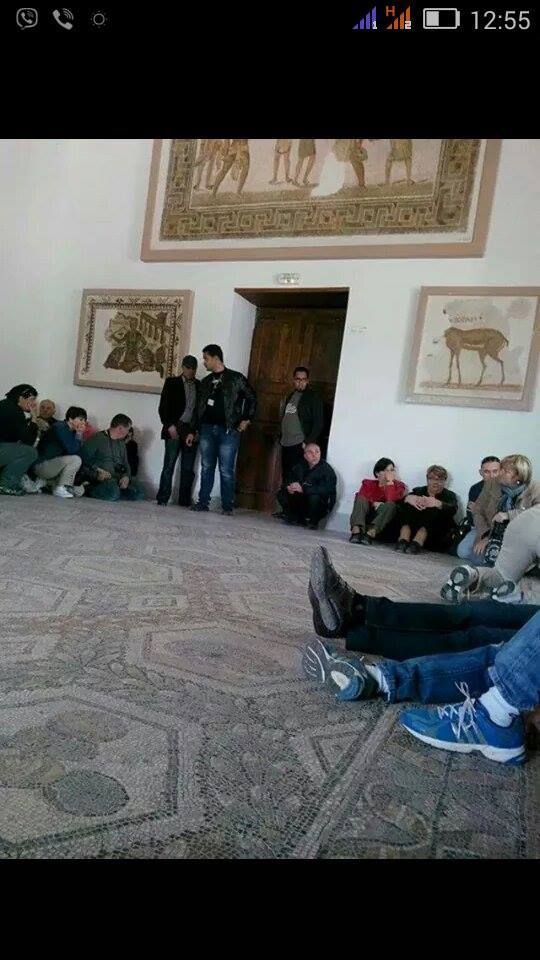
Armed men have seized hostages after opening fire at a leading museum in Tunisia's capital, leaving at least eight people dead and six wounded, including foreign tourists, authorities say.
Read more
Wednesday's attack was the first on a tourist site in years in Tunisia, a shaky democracy that has struggled to keep violence at bay.
"There are eight victims", including "seven foreigners", Mohamed Ali Aroui, the ministry spokesperson, said.
"Forces are being deployed. There are two or more attackers and hostages are still being held."
He added that the assault was carried out by "terrorists armed with Kalashnikovs".
The official did not provide nationalities for the foreign victims. Poland's Foreign Ministry announced that three Poles were among the wounded.
It was not immediately clear who the attackers were.

Security forces filled the area around the National Bardo Museum after the attack. The museum is located adjacent to the Tunisian parliament.
The parliament was evacuated right after the attack and politicians said gunfire could be heard at the scene, according to state TV reports.
Journalist Yasmine Ryan, reporting from Tunis, told Al Jazeera that ambulances are going in and out of the museum area cordoned off by the security forces.
"More than 15 police officers on guard at the entrance of the museum and all roads leading to the area are cordoned off," she said.
Al Jazeera's Nazanine Moshiri, who has covered Tunisia extensively, said: "The Tunisian national guard is well trained for this sort of situations. Presidential security forces are the particularly elite ones.”
Tweets from hostages
Local reporters said on Twitter that the attackers entered the Bardo Museum through the National Assembly and took several tourists hostage.
"The neighbourhood is in the process of being cordoned off; there is one armed man, maybe several on the museum side, there has been exchange of gunfire and probably hostages," she said, adding that was a great deal of panic at the scene.
Al Jazeera's Nazanine Moshiri, who has covered Tunisia extensively, said: "The Tunisian national guard is well-trained for this sort of situations. Presidential security forces are the particularly elite ones.”
Security issues
Tunisia recently completed its transition to democracy after the 2011 uprising against Zine El-Abidine Ben Ali, but security remains a key worry due to the emergence of armed groups.
It has been more stable than other countries in the region, but it has struggled with violence by armed groups in recent years, including some linked to the Islamic State of Iraq and the Levant (ISIL) group.
Tunisia also has fighters linked to al-Qaeda's North Africa arm who occasionally target Tunisian security forces.
The attack is a blow to Tunisia's efforts to revive its tourism industry.
The National Bardo Museum, built within a 15th-century palace, is the largest museum in Tunisia with collections covering two floors, and it houses one of the world's largest collections of Roman mosaics.
The attack comes a day after Tunisian security officials confirmed the death in neighbouring Libya of a leading suspect in Tunisian attacks and the killings of two opposition figures in Tunisia.
Ahmed Rouissi gained the nickname of the "black box of terrorism".

No comments:
Post a Comment